

We’re getting closer to our 4th Channel Partner summit. For us in AFT, it’s a very special occasion since it gives us the opportunity to personally thank all our Channel Partners for their great effort in helping AFT become the worldwide number 1 option for hydraulic solutions.

Starting with the hotel chosen for the Summit, this event will be not only be a three day working session where future marketing strategies will be discussed, it will also be a Summit seasoned with enjoyable surprises.

At AFT, we know that fun and work are not mutually exclusive and this will guide our meeting with our Channel Partners. An intensive working agenda combined with whitewater rafting, Pikes Peak Cog Railway, baseball, hamburger barbecue and excellent restaurants are just some of the Summit offerings to our distinguished guests.

If you’re a Channel Partner still making a last minute decision to join us, you’re still on time to make your reservations. Contact Lisa Converse (LisaConverse@aft.com) to be part of this unforgettable AFT experience.

Posted in Uncategorized | Tagged , | Leave a comment

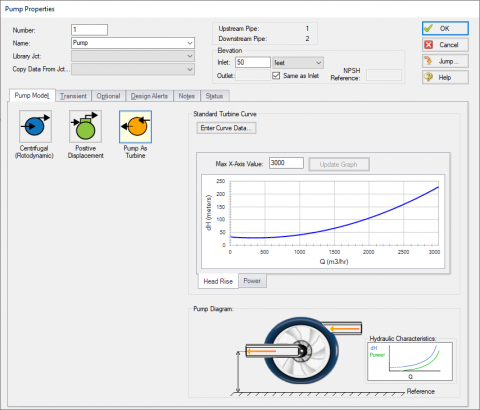
In AFT Impulse you can directly model a submerged pump. First, you will define your pump data exactly as you would normally, however you will only draw the discharge piping and not a suction piping. After doing this, you will check the box “Submerged Pump” at the bottom of the Pump Specifications Window.

You now have an additional required input field. The “Suction Pressure” can be entered as a Head (HGL) or a Pressure. When entered as a Head (HGL) value, this value is the actual liquid elevation in the supply reservoir. When entered as a pressure, this is the actual pressure seen at the elevation of the pump suction.

Finally it is worth clarifying the “Elevation” and “NPSH Reference” input, which can be a common point of confusion when modeling a submerged pump. With a submerged pump, the Inlet elevation is typically significantly lower than the Outlet elevation. If you uncheck the option “Same as Inlet” under the Elevation input field, then you will be required to enter an Inlet Elevation, an Outlet Elevation, and an NPSH Reference.

The NPSH Reference input field is the elevation to which the NPSHr curve on your pump datasheet is referenced to. Typically this is equal to the Inlet/Suction Elevation of the pump, but the engineer should verify this with the pump data sheet or with the pump vendor.

Posted in Tips and Tricks | Tagged , | Leave a comment

Do you ever wonder who the people are behind AFT? Do you wonder what our plans are for the future of our software products? Do you ever wish you could talk directly to AFT staff and communicate new features you would like to see? Do you ever wonder who else uses our products in the geographic region around you?

If you answered yes to any of the above, you may want to look into attending an AFT User Group meeting.

Last October we held our first User Group meeting in Houston. We had 24 attendees. The consensus was that there was a desire among AFT software users that User Group meetings be held regularly. In conjunction with our Houston Channel Partner Plant Design Solutions, we are working hard to make that happen.

As a result, we have another Houston User Group meeting scheduled for next week, April 11. If you can make it to the meeting then you can meet the President of AFT (that would be me!) and get a behind-the-scenes glimpse into our plans. We are holding this meeting at Dave & Buster’s, so there will be plenty of time for fun as well.

Besides hearing me speak about the future, you can also hear some AFT users speak about their use of our software. Finally, you can hear my co-presentation with an Intergraph engineer on integrating surge and pipe stress analysis. Here is a link to meeting information: Houston Area User Group Meeting – April 2013.

By the way, let me take this opportunity to plug our training seminar in Houston next week. The AFT Fathom seminar will be April 8-9, and AFT Impulse will be April 10-12. This is your chance to learn more about AFT software from the original developer of these products (again, that is me!). I will be teaching all five days. Space is still available. Click here for more information.

In May we will be holding the first meeting of our Calgary User Group. Our Canadian users can hear about modeling slurry hydraulics, a user presentation, and the same presentation on integrating surge and stress analysis that the Houston User Group will be hearing. Here is a link: Calgary Area User Group Meeting.

Finally, we are not ignoring our home state of Colorado. This Fall we will be holding the first Denver User Group meeting. I will be there, as well as several others from AFT. Keep an eye out for announcements!

If none of these locations are close enough for you and you would be interested in attending a User Group meeting closer to where you live, please email us at usergroups@aft.com and let us know!

Posted in President's Perspective | Tagged , , , , , | Leave a comment

The ability to specify default input parameters is a feature that is common to all AFT software products. Diameter, Friction Model, and Design Factors can be specified by default for pipes. Input properties for Junctions are specific to each junction type, so the only common default property is elevation. The default input options are found in “Parameter and Unit Preferences”. In general, this feature makes model building faster and more efficient.

The user should, however, be aware of how this affects the “Status” of pipes and junctions. The “Status”, to which I am referring, is the green light to run the model. Every model requires minimum amount of input data and some of that data may be filled in by default, but only upon opening the properties window. For example; the branch junction may appear to be incomplete until, upon opening the properties window, the previously empty Elevation input field is filled in automatically. I would encourage AFT software users to become familiar with all of the Options and User Preferences.


Fathom 8 Default Input Options found in the Tools menu under Options

Posted in Tips and Tricks | Leave a comment

The question of whether waterhammer analysis on new pipe systems is optional or required does not have a definite answer. In some cases it is clear – such as when the pipe system is being designed in compliance with ASME code (see How AFT Impulse Can Help Engineers Comply With ASME Codes). But in many cases it is up to experience and judgment whether or not to perform waterhammer analysis.

One of the issues complicating this question is that waterhammer events have a tendency to be non-intuitive. Thus even experienced engineers using intuition can be led astray.

I am reminded of a story one of our AFT Impulse customers told us about ten years ago. The engineer was an experienced waterhammer engineer and was fairly new to using AFT Impulse. They had a project which had 11 pipe systems. They decided to model ten of them with AFT Impulse and not model the 11th because of their previous experience which led them to believe it was not necessary. After construction one of the 11 systems had a waterhammer accident. Guess which one? That’s right - the one they did not model. That experience led this customer to mandate waterhammer analysis of all future piping systems.

This whole topic is fresh in my mind as I was teaching a training seminar on AFT Impulse a couple weeks ago. There I talked with some managers who told me they had made a policy decision to offer waterhammer analysis as a standard part of their pipe design service rather than as an optional add-on. This seems to be a growing trend.

There are some industries that historically have taken waterhammer very seriously. In my experience these include nuclear power, aerospace, and the pipeline industries. A couple decades ago waterhammer was viewed as a niche area for highly trained specialists running esoteric software or (pre-computers) using complicated manual calculations. This led to a situation where some industries did not pay as much attention to waterhammer as maybe they should have for the simple reason that it was too complicated. Instead engineers relied on overdesign.

It has always been the purpose of Applied Flow Technology to make engineering software more accessible to the mainstream engineer rather than just to specialists. We have put forth a great deal of effort to develop a well organized graphical interface which in essence lowers the bar for learning to perform waterhammer analysis. With this lower barrier to entry many companies using AFT Impulse are bringing waterhammer analysis inhouse for the first time.

So getting back to the original question of this article, a practical answer is that waterhammer analysis should be performed on any system whose failure would cause significant risk to life, property or the environment. Further, systems whose failure would cause significant economic or societal impact should also be analyzed.

Many systems carrying relatively harmless fluids such as water may not require waterhammer analysis if the impact should they fail is minimal.

Engineers and their companies need to assess which category their system fits into and proceed accordingly.

Posted in President's Perspective | Tagged , , , , , | Leave a comment

AFT Fathom 8 can be used to quickly and easily model multiple pump configurations with different pump speeds and impeller sizes.  First, determine a particular pump curve to use from either a manufacturer’s pump curve or pump curve verification test data.  Next, determine new pump curves for head and flow using the affinity laws considering either a change in pump speed or impeller size.  The multiple pump curve data sets will then be entered for each particular pump configuration.

In Figure 1 (click on the image to see it larger), there are a few pump configurations that have already been defined.  Suppose one more impeller size of 6 inches needs to be defined for the 3600 RPM pump.  Click the “Create” button, and then specify the RPM, Impeller Diameter with units, and a Description such as a pump’s model number.  Enter in the pump curve data points; click “Generate Curve Fit Now,” then click “Update Configuration Now.”

Figure 1: Defining multiple pump configurations for a single pump.

After the multiple pump configurations have been developed, they can be chosen in the Pump Properties window as in Figure 2.  When the specific RPM and Impeller size are chosen in the drop downs, the appropriate description and pump curve will be displayed.  Figure 2 shows the 6 inch impeller size for the 3600 RPM pump configuration that was added.

Overall, the capability to model multiple pump configurations will save an extensive amount of time for the engineer!  Rather than manually entering a new pump curve for each pump and for several different scenarios, the pump curve only needs to be entered ONCE and then the desired configuration can be quickly and easily chosen in the Pump Properties window.

Posted in Tips and Tricks | Tagged , | Leave a comment

I remember as a child watching an episode of the Twilight Zone where a man replaces all of  the workers in a factory with machines. The episode treated this topic as morally corrupt. And my childlike mind agreed. I remember feeling badly for all the people who lost their jobs and thinking, philosophically, how one day machines and computers could replace all jobs and no one would have any work to do. A quick Google search turned up the title of this episode: The Brain Center at Whipple’s.

Over the last year I have come across a host of articles, television news programs and conference speakers discussing the issues of technology and automation and how that impacts jobs. Here is a list:

The answer to the question “Is Technology and Automation Really Destroying Jobs?” is an easy one today and has always been an easy one. Yes.

However, looking back historically it is equally easy to see how technology and automation has created new jobs which has more than offset the ones it has destroyed. Examples of this are numerous.

One is the venerable typewriter which was first manual then electric. The typewriter held an important role in business and personal lives for nearly a century. Those typewriter manufacturing jobs are gone. But they were replaced by word processor software development jobs and personal computer manufacturing jobs. Who would rather be using a typewriter today over a laptop word processor?

The original poster children for anti-technology sentiment were the Luddites. An article last week in the Shreveport Times discussed the Luddites plight: THE GREAT RESET: Luddites raged against the machine and lost.

Time and time again over the last two centuries society has raged against jobs lost to technology and automation. Only to see new and usually better jobs created as a result.

Two centuries ago 90% of Americans worked on farms. One century ago 40% of Americans worked on farms. Today it is just 2%.

Think about it. Automation in the agricultural industry has destroyed 88% of the agricultural jobs in America over the last two centuries. And yet a large majority of Americans have jobs today.

The term often used to describe this process is “creative destruction”. The job I work in today developing commercial engineering software did not even exist 30-40 years ago. My job was created out of the destruction of the slide rule and calculator. As well as the loss in importance of large, centralized computers.

The question raised in the references I gave earlier is whether something has changed fundamentally in the economy such that new jobs are not being created anymore. Or, more specifically, whether manual labor jobs are being created in sufficient quantity to keep the less educated gainfully employed.

Keep in mind this claim has been made repeatedly for two centuries and every time it has turned out to be a case of crying wolf.

I personally can’t bring myself to believe this is generally true today. Is it true for short time periods? Sure. Until those displaced by technology can find new jobs in new industries. That displacement is often painful for those impacted. Is today in one of those short time periods? Or are we in a new world where manufacturing and physical labor jobs are going extinct?

As I indicated, I tend to come down on this being temporary. Innovation will create new industries and new jobs that today we cannot even imagine. Many of those jobs will require human beings. Until such time that those job functions can be automated. And then the cycle will repeat.

What do you think?

Posted in President's Perspective | 1 Comment

AFT Fathom has the ability to model heat transfer. The default mode (found in system properties) is “Constant Fluid Properties”. To avoid confusion in the default mode, several of the heat transfer input fields and option boxes are invisible or disabled until one of the following heat transfer modes are employed:

  • Heat Transfer With Energy Balance (Single Fluid)
  • Heat Transfer With Energy Balance (Multiple Fluids)

Upon selecting one of these heat transfer modes, the user may notice an option box labeled “Balance Energy at Junction”; found at the lower left of the first tab in the properties window for the Assigned Pressure or Reservoir junctions. In the case of a closed loop, this option will ensure that the temperature of the fluid leaving the junction is consistent with the fluid entering the junction. In the case of multiple fluid streams entering the junction, this option will ensure that the junction temperature is an accurate composite of the various influx temperature streams. If this box is not checked, the temperature of the fluid leaving the junction will always be the specified temperature and will not be affected by the temperature of the fluid entering the junction.

Posted in Tips and Tricks | Tagged , , | Leave a comment

Introducing Applied Flow Technology

Fluid transportation is an integral part of today’s society. AFT software products have emerged as world leaders in helping engineers move fluids more safely and efficiently. There are countless examples of this. We have chosen four such stories to help engineers understand how our products can help them solve problems and improve their engineering designs and operations. We developed a video to tell this story. Watch it here!

DuPont

The first story talks about how AFT Fathom helped DuPont solve a serious operational problem in three newly designed slurry systems. I co-authored a technical paper along with DuPont’s Dan Wood to describe this to industry.

NASA

AFT Impulse Video

The second story is about how AFT Impulse has been used by engineers at NASA’s Kennedy Space Center in Florida. NASA developed a waterhammer model of the sound suppression deluge system in the “flame trench” of the Space Shuttle launch pad. This system is a critical safety system which disburses acoustic waves that are generated by the ignition of rocket engines. If you want to learn more about this system you can watch some Youtube videos here and here.

This story is also part of a video specifically on AFT Impulse found on the AFT Impulse product page and also shown above.

I had the good fortune to visit the Kennedy Space Center for a training class on the 50th anniversary of John Glenn’s first American flight into space. You can read more about (and see pictures from) that interesting visit here.

GDF Suez in Poland

AFT Arrow Video

The third story is about how AFT Arrow was used by Energoprojekt Katowice SA in Poland to design a new a flue gas desulfurization unit for a GDF Suez plant on the Vistula River in Poland. After construction Energoprojekt Katowice got some measurements of the system and found they compared well to the predictions by AFT Arrow. I co-authored a technical article with Adam Klepacki on this.

This story is also part of a video specifically on AFT Arrow found on the AFT Arrow product page and also shown above.

University of Arkansas

AFT Fathom Video

The final story is about how AFT Fathom was used at the University of Arkansas at Fayetteville to model the campus chilled water system used for air conditioning buildings on campus. As a result the university is now saving over a million dollars each year on energy costs. The work was done by engineering firm TME Consulting Engineers and is described in this AFT case study.

This story is also part of a video specifically on AFT Fathom found on the AFT Fathom product page and also shown above.

Tell us what you think of our new family of videos and the stories behind them! Enjoy!


Posted in President's Perspective | Tagged , , , , , , , , , , , , , , , | Leave a comment

AFT Fathom provides a Three Way Valve which increases the Engineer’s capability to model system control.

The Three Way Valve Properties Window shows the three connecting pipes in drop-down lists, which allows users to specify which pipe is the combined flow pipe, and which two are the split flow pipes. By entering the loss profile through each flow path, and then by selecting the actual percent open, Fathom will calculate the actual loss values for each flow path.

Using the Three Way Valve in conjunction with the Goal Seek & Control module (GSC) increases the Engineer’s capability to model I&C logic in the system, thus allowing the Three Way Valve to modulate resistance in order to obtain a user specified pressure or flow.


Posted in Tips and Tricks | Tagged , , , | Leave a comment

The demand for our AFT Impulse waterhammer modeling software and associated training seminars has been growing steeply in recent years. I frequently travel internationally to teach  seminars on waterhammer. When I do I make it a point to find out what the engineer’s local language calls waterhammer.

For those who are not familiar with waterhammer, it is a transient phenomenon that occurs in liquid pipe systems when some event causes a departure from steady-state flow.

The English language term waterhammer is a bit confusing. As it has the word “water” in it, it implies a process involving water. But the English term has historically been applied by engineers to all liquid pipe systems regardless if the liquid is water or something other than water.

Some non-English languages have just directly translated the English word waterhammer – or have come up with the same words coincidentally. Two such languages are Chinese and Thai.

The Chinese word for waterhammer is “shuǐ jī”, meaning literally water hammer.

The Thai word for waterhammer is “kăn nám”, meaning literally hammer water.

The European languages are different. The Spanish word for waterhammer is “golpe de ariete” The French word is “coup de bélier”. Both mean the same thing. In English they mean “battering ram” –  the ancient devise used to attack castle gates.

Please send the word for waterhammer in your local language and its English translation. We will gather these and publish them at in the next issue of the AFT Pipeline!

Posted in President's Perspective | Tagged , , , , , , , | 1 Comment

Relief valves can be modeled in four different configurations with AFT products and they are shown in the figure below.  The required inputs for modeling a relief valve are the valve type, cracking pressure, valve loss model, and the exit pressure in the case of relieving to the atmosphere. 

There are three types of relief models available:  Internal (Cases 1 & 1a), Relief Valve at Exit (Case 2), and Inline Exit (Case 3).  In cases 1 and 1a, the relief valve is relieving into vent piping downstream of the valve.  Note that there is initially no flow in the pipe downstream of the valve until the relief valve cracks open (the pipes are assumed to be 100 % full of fluid and not empty).  Cases 2 and 3 both relieve directly to ambient conditions (ie, the atmosphere) and hence, an exit pressure (ie, the ambient pressure) is required as an input.

The “cracking pressure” is a required specification for each valve type.  In order for the relief valve to crack open, the following inequality must be satisfied.

Where:

dP = Cracking Pressure

PV,I = Relief Valve Inlet Pressure

PV,O = Relief Valve Outlet Pressure

-Cases 1 & 1a:  Inlet Pressure of the Pipe Downstream of the Relief Valve

-Cases 2 & 3:  Exit Pressure at Ambient Conditions

Posted in Tips and Tricks | 2 Comments

In 2010 the Walt Disney Company created a mind-boggling new night time show called World of Color at the Disney California Adventure theme park which is part of Disneyland Resort in Anaheim, California. For anyone who ever doubted that flow can be fun, you need to see this show!

A few weeks ago I saw World of Color while in California with one of my kids. While it was not the first time I have seen the show (OK, I think it was the eighth time), I and my son were reminded of how excellent this show is. There is nothing else like it.

The Walt Disney Company has a long history of using technology to tell stories and entertain. World of Color is a show they designed that uses water (and a lot of it), light, projectors, fire and music to entertain their guests.

The show uses 1200 synchronized fountains and 29 projectors to deliver Disney movie highlights and present them through a fluid media. The movies clips are shown right on a screen of water. Jets of water are propelled vertically 200 feet (65 meters) into the air during the show.

f

While I would like to say that AFT software was used on the piping for this show, the fact is I do not know. Disney is one of our customers at multiple locations including the theme park resorts. We do know some of the projects on which our software has been and can speculate on others based on questions they have asked. But they are a secretive group and we do not know about World of Color.

For some engineering information on World of Color check out this online article:

Eight types of fountains grace the show, among them four butterfly fountains, which create a graceful fluttering effect; six dancer fountains, with intertwining swirling dual nozzles; 10 geysers that shoot up more than 200′; 12 flower spouts, providing streams emulating blooming buds; 76 single-water whips with heads that can turn in any direction; 65 dual-water whips to create vertical patterns and fan-like designs; more than 400 chasers, so-named because their rapid sprays produce a chase effect; and more than 600 grid fountains, positioned 8′ apart, whose network of vertical sprays creates large-scale designs. Disney worked with The Fountain People, based in San Marcos, TX, to develop the fountain effects.

As an insight into AFT culture, Disney plays a role in our regular staff meetings. Thanks to our hard work and innovation and thanks to our large base of customers around the world, we have grown a lot in the last few years. This has led to a lot of new initiative and new ideas – and new versions of established products – as well as entirely new products (in the pipeline, so to speak).

To foster an environment of openness to new ideas, I established the “I Love That Idea!” award. This award is a mounted Mickey Mouse figure in his wizard hat and is passed around by staff when they hear a good idea from another staff member.

The popularity of this award led to a second award initiated by another staff member not for good ideas but for outstanding effort. It is a mounted Buzz Lightyear figure with a saying printed on it “Good Work, Space Ranger!”.

As the President of AFT, I want our workplace to be a balance between excellent technology and just plain fun. My experience with World of Color helps give me ideas and inspiration which contribute to our creation of the best pipe flow simulation products in the world. That is part of the reason we say that AFT provides Dynamic solutions for a fluid world™.

And go see World of Color when you get a chance!

Posted in President's Perspective | Leave a comment

One of the many new features in Fathom 8 is the ability to show images in the annotation box.

This simple feature will allow the engineer to easily and clearly communicate a vast array of information through the Workspace and Visual Report.


To add an image to the Workspace or Visual Report, as seen above, select the Annotation tool from the toolbox.

Then select the “Line/Arrow/Image” tab and specify the file path to your image.

Once the image is selected, click OK. The image box shown on the workspace can be easily moved and resized.

Posted in Tips and Tricks | Tagged | Leave a comment

AFT Fathom 8 began shipping last week. And we are excited. The release of AFT Fathom 8 coincided with the unveiling of our new logo, new website and newly branded material. It is not an understatement to say this represents a new era for AFT.

What does all of this mean for the future?

The new, more modern look and feel of AFT Fathom 8 is based on a new underlying architecture. We will be working hard to move all of our other products to this architecture as quickly as possible. Our best guess is that AFT Impulse 5 will be available in first quarter of 2013 and AFT Arrow 5 will be available in second quarter of 2013. AFT Mercury 8 and AFT Titan 5 should also be available in he first half of 2013.

In the fourth quarter of this year we plan to have an updated settling slurry module (SSL) for AFT Fathom 8 which includes the SRC method. This will augment the current method developed by Wilson, Addie, Sellgren and Clift.

In 2013 and the following years expect to see more new products from AFT. These will include new add-on modules as well as entirely new products.

Along with new products expect to see new support offerings by way of training, videos and webinars.

Training Seminars

In recent years we have hosted four training seminars a year in our home office in Colorado Springs, Colorado here in the USA. In 2013 we will begin hosting open seminars in Houston at the offices of our new channel partner Plant Design Solutions. The training schedule for next year will be developed in the next month or two. Further, we are now partnering with our international channel partners to offer seminars around the world. This includes seminars in:

Canada (June, Calgary)

South Africa (October 22-26, Johannesburg)

Peru (November 5-9, Lima)

China (November TBD, Beijing)

User Group Meetings

The first user group meeting ever for AFT software will be on October 24, 2012 in the Houston area. I am planning to be there to present information on the new AFT Fathom 8. We welcome everyone but especially those in the Gulf Coast region to attend.

Video Tutorials

You may have noticed in recent months we now have Quick Start video tutorials available for AFT Fathom (versions 7 and 8), AFT Arrow and AFT Impulse. These are in English units whereas metric units are coming soon.

The video tutorials are being expanded to include topical tutorials on a wide range of modeling issues of interest to our customers.

Also, AFT Fathom 8 now has links in the online Help system back to in context video tutorials as well as in context tips and tricks articles on our website.

Webinars

AFT has been offering webinars on our software products on a weekly basis. Sign up to learn more about our software.

Technical Support

Our high quality technical support has not changed. We have added support staff over the last two years and endeavor to provide everyone with timely support to your questions.

We also have added new channel partners and now have a total of 30 around the world. They are available in your time zone and language to provide technical support. We work closely with them to obtain answers to your questions.

In conclusion, we are working hard to supply our customers with the best and most up-to-date modeling software products,  as well as first rate service. We trust that our new logo, website and materials reflect the world class company that you have helped Applied Flow Technology become.

Posted in Uncategorized | Leave a comment

DuPont experienced severe operational problems on a new product line that put at risk a multimillion dollar investment. The system involved pumping of a non-Newtonian fluid which behaved as a Power Law fluid. AFT Fathom’s unique capability to model valves and fittings was critical to identifying the cause of the problem and guiding the solution.

DuPont engineer Dan Wood teamed with AFT President Trey Walters to present a technical paper this week at the 28th International Pump User Symposium in Houston, Texas. There they presented the problem and resolution which involved a new valve and fitting calculation method developed by AFT called the Adjusted Turbulent K Factor (ATKF) method.  Read the full paper on “Operational Problems in Pumping Non-Settling Slurries Resolved Using an Improved Laminar Flow Pipe Fitting Loss Model” here.

Posted in Uncategorized | Leave a comment

We at Applied Flow Technology are really excited about the new version of AFT Fathom 8 coming in September. Once our customers get their hands on it we are confident they will be equally excited. This version represents the most significant upgrade since AFT Fathom 4 was released in year 2000. It will further establish AFT Fathom as the world’s leading pipe flow modeling tool.

The prices are increasing soon so if you are planning to order new AFT Fathom licenses or SUM annual support do not delay. Read further for more details.

The effort to move AFT Fathom from version 7 to 8 turned out to be quite an undertaking as it involved a platform shift for the source code. It required several years of work, which is why there has not been a new version available in the last few years. For end users it means the availability of both a traditional 32-bit version of AFT Fathom 8 as well as a native 64-bit version. It also means better compatibility with future versions of Microsoft Windows. And finally it means a host of usability enhancements and new features to make your job easier than ever. A list of new features and a video tutorial can be found here.

This new platform for AFT Fathom is going to allow us to do many things not possible under the old platform. Expect to see lots of innovative new features in the next few years.

Below is a list of common questions about AFT Fathom 8.

Will the Price of AFT Fathom 8 Change?

Yes. This was announced in May, 2012 to all newsletter subscribers and everyone on the AFT Fathom notification list, as well as on the home page of our website.

US customers can see the new prices here. International customers can contact their local channel partner for pricing. Find your local channel partner here. Orders of AFT Fathom and SUM reinstatements received within the next 1-2 weeks before AFT Fathom 8 is released can be obtained at the current prices.

In addition to new prices on the base product, other changes include:

- Increased SUM reinstatement price in September when AFT Fathom 8 is released.

- Increased base SUM price on January 1, 2013

- New annual leases available

For these and other details on all new pricing issues click here.

 How Do I Get the New Version of AFT Fathom?

1. If you are an annual SUM subscriber (or you have purchased your license within the last year – which means you have a first year SUM included) your company will receive a package with the upgrade at no charge as soon as we get it shipped in September-October. If you want to start using it sooner contact AFT and we can get you a new license number.

2. If you are an AFT Fathom customer and your annual SUM is not current, you can reinstate the SUM. The price for reinstatements will increase in the next 1-2 weeks and when the base SUM price increases on January 1, it will increase again by virtue of the base price increase. Get your reinstatement order in as soon as possible to obtain the lower price.

3. If you are not an AFT Fathom customer, orders for AFT Fathom 7 placed in the next 1-2 weeks at the current lower price will receive a free upgrade to AFT Fathom 8. Orders received after that will be taken at the new prices.

Our SUM is current but we want to renew early to get the old prices. Can we do that?

Yes, orders for SUM renewals will be accepted at the old prices until December 31 for up to three years in advance.

Why Should We Upgrade to AFT Fathom 8?

AFT Fathom 7 is based on a programming platform which Microsoft stopped developing in 2002 and stopped supporting in 2008. Overall AFT Fathom 7 has worked fine on all versions of Microsoft Windows up through Windows 7. However, minor compatibility issues exist. We are concerned compatibility issues will increase for future versions of Windows. The new platform for AFT Fathom 8 will not have these issues.

In addition, while the 32-bit versions of our products generally work fine on 64-bit versions of Windows, AFT Fathom 8 allows native support for 64-bit operating systems.

Finally, AFT Fathom 8 has many new features and interface enhancements which you will want to access.

When Will Training Be Available for AFT Fathom 8?

We will be working on a new course for AFT Fathom 8 starting in September and hope to have this available in October. Courses before the new material is available will be on AFT Fathom 7 and include an AFT Fathom 8 preview. The new AFT Fathom 8 course will be substantially revised and improved. For training schedules check here.

Posted in President's Perspective | Tagged , | Leave a comment

Many times when modeling heat transfer using heat exchangers in AFT Fathom, significant temperature differences across the heat exchanger can have a major impact on the accuracy of the heat transfer results.  This can especially become a problem with non-linear heat capacity relationships.  The heat transfer across the heat exchanger in the model below is calculated from the temperature difference across the heat exchanger and the arithmetic average heat capacity.

One way to enhance the accuracy of the heat transfer results is to model the single heat exchanger junction, J2, as multiple heat exchangers as shown in the below model.

The “Specified Heat Rate In vs. Flow” thermal model would be reasonable to use for each heat exchanger (see the following link for a discussion on this type of thermal model http://www.aft.com/blog/2012/02/21/problems-with-heat-exchanger-specified-heat-rate-in-constants/).  A design factor could be used for reducing the junction heat transfer for each heat exchanger (ie, if using five heat exchanger junctions to model one heat exchanger, a design factor of 0.2, or 1/5 would be used for each junction).

Apply the full pressure drop of the original heat exchanger to the first heat exchanger in the series.  Pipes P101 and P106 will have the same specifications as pipes P1 and P2, respectively.  The remainder of the pipes can be short frictionless pipes.

The end result will be a more accurate heat transfer solution due to the smaller increments of the average heat capacity used for each heat exchanger calculation.

Posted in Tips and Tricks | Tagged | 1 Comment

The next generation of AFT Fathom will be released in September 2012, offering engineers unprecedented modeling and user interface capabilities.

Pricing Highlights:

  • Second and additional seats, on the same purchase, of a network license will receive a 10% discount.
  • Customers who maintain a current Support, Upgrade & Maintenance (SUM) subscription on their network licenses will receive a 10% discount on future purchases of that product.
  • The AFT Fathom Cost Estimation (CST) and Non-Settling Slurry (NSL) modules will no longer be offered as separate items but will be included as part of the core AFT Fathom 8 product.
  • Package discounts for buying modules at the same time as full licenses will be discontinued.
  • The reinstatement prices for lapsed SUM subscriptions for all software products will increase in September with the release of AFT Fathom 8.
  • Annual renewal prices for AFT Fathom 8 SUM subscriptions will increase January 1, 2013.
  • Annual SUM subscription renewal prices for other AFT software products will go into effect when each new version is released.
  • AFT will offer a corporate pricing program. Corporate pricing will provide 20-40% off standard prices.   Details here.
  • In addition to quarterly leases, AFT will now offer annual leases. Modules will no longer be leased.
  • New lease prices for AFT software products will go into effect at the release of each new version.
  • Customers who lease a product can get credit for one half of the lease price if the license is purchased before the end of the lease period.

US customers can see the new pricing at the links here. International customers should contact their local AFT distributor for new pricing information.


Posted in Uncategorized | Tagged | 1 Comment

In the process of making specification changes to a sequence of pipes or junctions, one may find it easier to jump from one pipe (or junction) to the next without closing the current specifications window. This can be accomplished by clicking the “Jump” button in the specifications window.

Clicking the Jump button will open a dialog where the next pipe or junction number can be selected. Once the selection is made, clicking on the jump button will advance the existing specifications window to the selected pipe or junction number.

To make things even faster, pressing F5 within an active specifications window will automatically advance to the next pipe or junction number. This can be a significant time savings when the location of each pipe in the sequence is not obvious. The user can avoid searching for pipes by simply pressing F5 until the desired pipe or junction is current.


Posted in Tips and Tricks | Tagged , , , , | Leave a comment

This article is the second in a two-part series on the future of engineering. Part 1 was discussed last month here.

I was teaching a training class a few months ago at Kennedy Space Center in Florida and had the good fortune to get a guided tour of the space center by “Rob”, one of the attendees in my class. I wrote about this tour in a recent article on the 50th anniversary of John Glenn’s flight into space.

Rob is an engineer’s engineer who tinkers in his garage on weekends. Rob is a “greybeard” which means he has a lot of experience and is in the final third of his career. Rob has some concerns about the future of engineering which he expressed to me during our after hours tour. He was concerned that today’s younger generation does not tinker like his generation did and, in his case, still does. He wondered if this lack of tinkering would mean a next generation of engineering graduates who are more out of touch with the physical world. Taking this one step further, I think Rob was concerned about the future of American technical leadership – in the space industry and in general. His concern is shared by others.

My first response to Rob is that tinkering is not dead in today’s world. I told Rob about my oldest son who just finished his third year in Mining Engineering. He is a tinkerer and has long had a fascination with pyrotechnics and explosives. His engineering education has given him yet more technical knowledge – which he has applied to creating his own custom solid rocket fuels for model rockets. This summer he is working in a mine in Colorado getting his hands dirty. Well, he told me he gets dirty everywhere!

A second example is one of the engineers on staff at AFT who graduated relatively recently. He told me when he was in engineering school he built flow experiments and mounted them on the back of his car and drove around to measure what was happening in the flowfield behind a car.

I think there may be more tinkerers around than Rob thinks.

I suppose the larger question is what skills today’s younger generation needs in order to contribute to the success of their own and their nation’s future. Is hands-on tinkering in the garage as valuable today as it was to Rob’s generation a few decades ago?

In Part 1 I talked about my three sons currently pursuing engineering educations. That means I have spent a bit of time in recent years with them touring some top notch prospective universities. All I could say was, wow! The efforts to which these universities have gone to connect their students with the real world through their lab programs is very impressive. Compared to what I had available some 25 years ago, the facilities at my sons’ universities are nothing short of amazing. Further, there appears to be a much greater emphasis on getting undergraduates involved in professor-directed research programs which were reserved for graduate students when I was in school.

I think my sons and their generation will have a better real world connection when they graduate than I had. As far as today’s young engineering generation goes and the future of American technical leadership, I do not share Rob’s concerns. That does not mean that I do not have concerns about the future of American technical leadership.

An essential part of what is learned by those who tinker is failure. Thomas Edison’s quest to invent the light bulb involved over 9000 failures.

When asked if he felt like a failure and if he should give up, Edison responded with this famous quote, “Young man, why would I feel like a failure? And why would I ever give up? I now know definitively over 9,000 ways that an electric light bulb will not work. Success is almost in my grasp.” (see http://www.squidoo.com/thomas-edison-quotes)

Failure is important. The failures of tinkerers is an essential part of any future successes. To my mind this tolerance for failure applies in the larger scale to societies.

I think a much bigger threat to American technical leadership is the American socio-political environment. The process of “creative destruction” is essential to moving a technology-oriented economy forward. Creative destruction involves accepting failure. Societies that are more focused on job protectionism rather than on allowing some low performing companies or industries to fail will be challenged in moving forward. Along with this is the society’s support for new startup companies and industries. These are a significant part of the job creation engine needed for displaced workers to find a place to land.

The American presidential election this Fall will indicate which way America is leaning. And that is a far bigger concern to me than whether today’s young generation has enough tinkerers.

Posted in President's Perspective | Tagged | 1 Comment

In all of our core products (Fathom, Arrow, Impulse, Mercury, Titan), we offer the ability to save graph sets. This has the potential to save a lot of time when reviewing multiple graphs of different parameters. In order to define a graph set, first construct and customize the graph you would like to review. Then open the “Select Graph Data” window from the View menu and click the button “Save Set As…”. After entering a graph set name, click ok, and you have just created a graph set!

At this point you can modify any parameters in your model, re-run the analysis, and then from the Select Graph Data window you will have a list of all saved graph sets in the lower left that you can load, saving the time of redefining and customizing specific graphs.

Posted in Tips and Tricks | Tagged , , , , | Leave a comment

Summary

Engineers are often responsible to design systems to comply with codes and standards. In recent years codes that apply to waterhammer and surge pressures have become more prominent. Increasingly AFT Impulse is being used to help engineers comply with such codes.

Once AFT Impulse has calculated the maximum pressure due to a transient event, what shall the designer do with this value? The answer to this question depends on the code that is being used as the piping design basis. In this article we’ll be discussing how two important piping design codes – B31.4 and B31.3 – deal with surge pressure (transient pressure) and how the results from AFT Impulse shall be used in order to comply with their requirements.

Codes

  1. ASME Code for pressure piping B31.4. Pressure Transportation Systems for Liquid Hydrocarbons and Other Liquids.

401.2 Pressure

401.2.2 Internal Design Pressure. The piping component at any point in the piping system shall be designed for an internal design pressure which shall not be less than the maximum steady state operating pressure at that point, or less than the static head pressure at that point with the line in a static condition.

The maximum steady state operating pressure shall be the sum of the static head pressure, pressure required to overcome friction losses, and any required back pressure. Credit may be given for hydrostatic external pressure, in the appropriate manner, in modifying the internal design pressure for use in calculations involving

the pressure design of piping components (see para.404.1.3). Pressure rise above maximum steady state operating pressure due to surges and other variations from normal operations is allowed in accordance with

para. 402.2.4.


402.2.4 Ratings - Allowance for Variations From

Normal Operations. Surge pressures in a liquid pipeline are produced by a change in the velocity of the  moving stream that results from shutting down of a pump station or pumping unit, closing of a valve, or blockage of the moving stream. Surge pressure attenuates (decreases in intensity) as it moves away from its point of origin.

Surge calculations shall be made, and adequate controls and protective equipment shall be provided, so that the level of pressure rise due to surges and other variations from normal operations shall not exceed the internal design pressure at any point in the piping system and equipment by more than 10%.

From B31.4 extracted paragraphs the following conclusions can be drawn:

  1. B31.4 refers directly to the maximum value of the overpressure, establishing a limit of 10% above the Steady State operating pressure.
  2. As the reference pressure B31.4 uses the static state pressure, in other words the designer shall use the Max. Static pressure from AFT Impulse instead of the Max. Stagnation pressure.
  3. Operating pressure shall be the reference for design instead of the design pressure calculated for the pipe.
  1. ASME Code for pressure piping B31.3. Process Piping

301.2.2 Required Pressure Containment or Relief

  1. (a) Provision shall be made to safely contain or relieve

(see para. 322.6.3) any pressure to which the piping may be subjected. Piping not protected by a pressure relieving device, or that can be isolated from a pressure relieving device, shall be designed for at least the highest pressure that can be developed.

(b) Sources of pressure to be considered include ambient influences, pressure oscillations and surges, improper operation, decomposition of unstable fluids, static head, and failure of control devices.

(c) The allowances of para. 302.2.4(f) are permitted, provided that the other requirements of para. 302.2.4 are also met.


302.2.4 Allowances for Pressure and Temperature Variations.

Occasional variations of pressure and/or temperature may occur in a piping system. Such variations shall be considered in selecting design pressure (para. 301.2) and design temperature (para. 301.3). The most severe coincident pressure and temperature shall determine the design conditions unless all of the following

Criteria are met:

(a) The piping system shall have no pressure containing components of cast iron or other nonductile metal.

(b) Nominal pressure stresses shall not exceed the yield strength at temperature (see para. 302.3 of this Code and Sy data in BPV Code, Section II, Part D, Table Y-1).

(c) Combined longitudinal stresses shall not exceed the limits established in para. 302.3.6.

(d) The total number of pressure-temperature variations above the design conditions shall not exceed 1000 during the life of the piping system.

(e) In no case shall the increased pressure exceed the test pressure used under para. 345 for the piping system.

(f) Occasional variations above design conditions shall remain within one of the following limits for pressure design.

(1) Subject to the owner’s approval, it is permissible to exceed the pressure rating or the allowable stress for pressure design at the temperature of the increased condition by not more than

(a) 33% for no more than 10 hr at any one time and no more than 100 hr/yr, or

(b) 20% for no more than 50 hr at any one time and no more than 500 hr/yr.


From B31.3 extracted paragraphs the following conclusions can be drawn:

  1. Surge pressure is included in the group of loads called occasional.
  2. The piping design pressure shall take into account the maximum pressure that may occur in the system including surge pressure due to a transient event.
  3. The maximum surge pressure shall not exceed in any case the test pressure calculated for the pipe.
  4. The maximum stress produce the loads created by the surge pressure shall not exceed: 1.33 Sh (Sh=allowable stress for the operating temperature).

In order to meet the 3rd requirement the AFT Impulse user shall calculate the forces originated on  the bends of the system  and feed this data to a pipe stress program (see Trey- Jim Wilcox article: Evaluating Dynamic Loads in Piping Systems Caused by Waterhammer; http://www.aft.com/training/white-papers)

Conclusion

The allowable pressure due to a transient event (surge allowable) varies from code to code. B31.4 refers directly to the maximum pressure value establishing as a limit 10% above the operating pressure. B31.3 not only establishes a surge pressure allowable (Test pressure) but also deals with the mechanical effect in the pipe, limiting the limiting piping  stresses to a maximum of 33% above Sh (Sh=allowable stress for the operating temperature).


Posted in Uncategorized | Tagged | 1 Comment

Beginning with the release of AFT Fathom 8 in the third quarter of 2012, AFT will be offering for the first time ever a corporate purchasing program. This program will offer substantial discounts on new software licenses, SUM maintenance licenses, and training. The discounts will be based on the quantity of licenses with current SUMs. The SUM is a Support, Upgrade and Maintenance program AFT has offered since 2000.

Corporate clients can qualify for one of three levels: Platinum, Gold and Silver. Platinum corporate clients will receive a 40% discount on all software and training purchases from AFT. Gold level will receive a 30% discount. Silver level will receive a 20% discount.

The corporate level is determined by how many SUMs are currently maintained by clients and a point scale for each SUM.

Table 1. Points towards corporate licensing.

Clients achieve different corporate pricing levels by the total number of points they have with current SUMs as in Table 2.

Table 2. Point levels for each corporate level

For example, consider a client called Mountain Top Engineering who has current SUMs for 10 AFT Fathom licenses, 4 GSC licenses for AFT Fathom, 2 XTS licenses for AFT Fathom, 3 AFT Arrow licenses and 1 AFT Impulse license. Their point total is:

Table 3. Points for Mountain Top Engineering company. 

Based on Table 2, Mountain Top Engineering with 74 points would be a Silver Corporate client and be eligible for a 20% discount on any future software purchase or SUM renewals. Platinum and Gold corporate clients would receive discounts also on training seminars. Software purchases (including modules) are eligible for discounts regardless of whether the client has purchased that product or module before. Discounts on leases are not available.

Discounts on training apply for seminars at client sites or at AFT hosted seminars.

Posted in Uncategorized | 1 Comment

We have been hard at work for the last several years on the next generation of AFT software products. These new versions will extend AFT’s leadership in the global marketplace and offer engineers unprecedented modeling and user interface capabilities.

Many of our products have had no price increases for five or even ten years. Further, we will be bundling modules into AFT Fathom 8 and AFT Arrow 5 which in the past were offered at extra cost. US customers can see the new pricing at the links below. International customers should contact their distributors for new pricing information.

AFT Fathom 8 New Pricing
AFT Arrow 5 New Pricing
AFT Mercury 8 New Pricing
AFT Impulse 5 New Pricing
AFT Titan 5 New Pricing

Second and additional licenses on the same order will receive a 10% discount. If a client has a current SUM and orders new licenses of a product, they will receive a 10% on all new licenses of that product.

SUM prices for AFT Fathom 8 will not change from current prices until October 1, 2012 at the earliest. Other SUM prices will go into effect when each new version is released.

For the first time ever, AFT will offer a corporate pricing program. Corporate pricing will provide 20-40% off standard prices. Details are discussed in a separate article here.

The AFT Fathom CST and NSL modules will no longer be offered as separate items but will be part of the core AFT Fathom 8 product. Similarly the AFT Arrow CST module will be part of the core product.

The AFT Fathom 8 SSL module will have some significant enhancements which will be announced at a future date.

Package discounts for buying modules at the same time as full licenses will be discontinued.

For many years AFT has offered quarterly leases. These will still be the same as before. For the first time AFT will offer annual leases.

Leases: prices for upcoming AFT products to go into effect at the release of each new version

Companies who lease a product can get credit for one full quarter towards a full license purchase if the order is placed before the end of the lease. Modules will no longer be leased.

Posted in Uncategorized | 2 Comments

May and June are the time for graduations in the USA. My third son graduated from high school this month and will be pursuing a major in Aerospace Engineering. My oldest son is finishing his third year in Mining Engineering and my second son has started into a Mechanical Engineering major. Engineering education and the future of engineering is a frequent discussion topic around our home.

So what is the future of engineering?

Well, it is safe to say that a knowledge-based society like today’s society will always need engineers. From that point of view the future of engineering is secure.

However, more troubling to many engineers at different points in their careers is the real or perceived lack of job security. In many Western nations there are industries that have seen downward pressure on employment demand for engineers due to technology outsourcing to emerging economies. But the story is not necessarily bright for engineers in emerging economies either. I spent 10 days in India in late 2011. India graduates a large number of engineers. However, it seems many Indian engineers are looking to take their engineering skills abroad because of insufficient demand inside the country.

If one cannot have a secure job then is engineering a good career choice?

It has been said that in today’s world the only constant is change. It should be obvious to all engineers that an engineering education is no longer enough. With the rate of change in technology, engineers need to be re-trained over and again. I have heard that an engineer needs to be re-trained three times in his or her career.

I think we can stop at this point and draw a conclusion about the future of engineering:

An engineering education is not enough. An engineer needs to plan for continual self-education if he or she wishes to continue to practice in this rapidly changing career.

With this reality, engineers would be well advised to look for employers who have a track record of investing in their staff. But engineers should not depend completely on their employer. They should take some initiative to re-educate themselves.

Another thing I tell my oldest son (the Mining Engineering student) is not to pay so much attention to the monetary compensation of any job. By far what will matter most to an engineer’s future is the experience they gain on the job. A highly compensated engineer that is not getting good experience has a higher chance of being out of a job some day. So we can now draw a second conclusion about the future of engineering:

Employers pay engineers in two ways – in salary and in experience. In the end the experience gained is what gives more secure employment prospects.

Recent decades have seen an increase in globalization trends. The BRICS nations (Brazil, Russia, India, China and South Africa) have economies that are growing faster than many of those in developed Western nations. They all have significant internal societal and political challenges. Nevertheless it is safe to say that globalization trends will increase and not decrease.

With the global scope of Applied Flow Technology (we have clients in 70+ countries) I have been fortunate to have traveled extensively internationally to work with clients. My engineering student sons mentioned earlier have been fortunate to have traveled with me on many occasions. Moreover, they have each lived abroad for a semester while in high school and learned a foreign language. The second language learned and increased global awareness will serve them well in the global marketplace.

A third conclusion about the future of engineering can be drawn:

Increases in globalization means engineers should think globally about their future. Engineers should pay attention to global trends and try to develop their skills such that they will be relevant not just to future domestic demands but also future global demands. This could include living abroad for a time period to gain improved understanding of other cultures and/or learning a second language.

Another obvious trend is that towards communication and networking. My sons and their generation are very comfortable with the virtual world of mobile access and social networking. It is clear that this will increasingly influence how engineering is performed. Bill Knoke talks about “the placeless society” (see The Hyperconnecting Corporation) and how this is transforming businesses. We can add this as a fourth conclusion about the future of engineering :

Mobile and remote networking will continue to change how engineering work is performed. Becoming more comfortable with remote, collaborative processes and tools will allow an engineer to better fit into future work processes.

Consider these trends as you plan your career. Next month we will continue the discussion on the future of engineering.

Tagged | 4 Comments

AFT Arrow can be used to model various types of choking such as restriction choking, endpoint choking, and expansion choking.  A useful parameter in AFT Arrow’s output is the “Sonic Flow Area” and this is the flow area in which sonic choking will occur.  Comparing the sonic flow area to the actual flow area can help determine the margin between not choking and choking.

The figure below provides a conceptual understanding of comparing various sonic areas to the actual flow area of a compressible system.  If one defines their system such that the sonic area (ASonic,1) is less than the flow area, the portion of the system will not choke.  If the sonic area (ASonic,2) is greater than the flow area, then there will be choking.

In summary, to avoid choking, adjust the flow area such that it is greater than the sonic area.

Posted in Tips and Tricks | Leave a comment

A frequently asked question at our training seminars – usually during a break or over lunch – is how we came up with the name “Arrow”. More completely, the product is named AFT Arrow™ and it is considered by many as the world’s leading compressible pipe flow modeling software product.

There is a similar story behind the naming of AFT Fathom™ and I told that story several months ago here.

The story behind the Arrow name is rooted in the beginnings of Applied Flow Technology as a company. So let’s go back to 1995.

AFT Fathom was released in early 1994. While interest was immediately strong, we also received many requests for a version which performed compressible flow modeling in pipe networks. When I started Applied Flow Technology in 1993 I already had in mind to develop a product for compressible pipe flow. So work on product #2 began in 1994 soon after AFT Fathom 1.0 was released. However, I found out first hand what all fluid flow engineers already know – gas flow calculations are much harder than liquid flow. Especially in pipe networks.

Work on a compressible flow product was set aside in late 1994 in order to make some improvements to AFT Fathom, and version 2 of AFT Fathom was released in early 1995. Then attention was turned back to compressible flow.

But what should AFT’s second software product be called?

I remember coming up with twenty different names to choose from. I can’t remember hardly any of them but I do remember one of them being “Stratus”. So AFT Arrow might have become AFT Stratus if I had made that rather misguided choice in 1995.

But then a moment of fate intervened.

I was working heavy hours in those days and my wife decided to take our young children to visit grandparents and I took them to the airport to send them on their way. On the way back home – AFT’s office was in the basement of our home in those days – I was driving on the highway and passed an RV (a “recreatioanl vehicle” for international readers – it is like a mobile vacation home).

The brand name for the RV displayed in large letters on its back was “Arrow”. And like an arrow which pierced me from out of the blue, I immediately realized AFT’s second product would be called “AFT Arrow“.

As challenging as it was to find a name for AFT Arrow, developing the product was even more challenging. I did not want to settle for a simplified ideal-gas, adiabatic-type of solution methodology to which other software companies have resorted. I wanted the whole thing – heat transfer, real gas modeling and fully capable sonically choked modeling capability. This took considerable effort and research, including the development of many highly innovative and proprietary solution techniques. In the end AFT Arrow was commercially released in October, 1995. Orders surged immediately because of the market awareness already created by AFT Fathom.

Today we are proud to offer AFT Arrow as the most accurate and capable compressible pipe flow software available on the market.

Tagged , , , , , , | Leave a comment

All of the pipe numbers in Fathom must be unique. When adding a pipe to a model, the new pipe number will be incremented based on the highest pipe number currently in the model. For example, you may only have 25 pipes on the workspace, but if the highest pipe number is 100, a new pipe will automatically be assigned number 101. After several iterations of deleting and adding new pipes, the numbering scheme may be reduced to chaos.

AFT Fathom provides three tools to quickly and easily renumber pipes. They can be found in the Edit menu.


The Renumbering Wizard allows the user to change pipe numbers one at a time. Simply enter the starting pipe number and the increment size, then go to the workspace and click on the pipes you want to change.

Automatic Renumbering allows the user to change all pipes or junctions in a selected area at the same time. If you need to renumber the entire mode, this would be an easy way to do it.

Incremental renumbering will change all pipes or junctions in a selected area by adding an offset to each pipe. For example, if your pipe numbers range from 1 to 100, but you want one section of the model to be set apart, you can select the desired region and increment all of the pipes by 1000. When viewing the model data or output windows the incremented pipes will be easy to identify.

Posted in President's Perspective, Tips and Tricks | Tagged | Leave a comment

A common task among pipe stress engineers is to evaluate loads on pipe systems caused by waterhammer. Since AFT Impulse 4.0 was released our users have had the ability to calculate waterhammer-induced unbalanced forces for use in any pipe stress analysis application. In addition, our users can create specially formatted transfer files for direct use in CAESAR II and TRIFLEX.

However, the process of calculating such forces in AFT Impulse and then applying them in pipe stress software is not as straightforward as it sounds. Our customers have asked for assistance in this process. I have teamed with Jim Wilcox of CodeCAD – AFT’s distributor in Canada – to write a white paper on how to generate forces in AFT Impulse and apply them in CAESAR II. Jim’s many years of experience with CAESAR II as well as his familarity with AFT Impulse as a distributor was a key factor in us being able to create this unique document.

Here is a link to where you can download the white paper: Evaluating Dynamic Loads in Piping Systems Caused by Waterhammer.

As a point of interest, this effort began as a conference presentation at Intergraph’s CADWorx and Analysis University in 2009. We were invited back again in 2011 and presented a paper entitled “Transient Hydraulic Analysis for CAESAR II Evaluation”. After the 2009 presentation we began work on a white paper and it took us a few years to refine the example and the content.

This version of the white paper is in U.S. customary units and we are currently at work on a metric version.

We expect this white paper to offer significant help to those performing this important engineering task. Please tell us what you think!

Tagged , , , , | Leave a comment

AFT Fathom and AFT Arrow have the option to include energy costs in the Output. To utilize this option, first open and fill out the “Cost Settings” window which can be opened from the Analysis dropdown menu.

Next open the specification windows for the pumps that you would like to calculate energy usage for, and select the option to “Include Cost in Report” from the “Cost” tab.

After running the model, you will be able to review the new cost data in the output.  The cost report is configurable in the Output Control window.


Posted in Tips and Tricks | Leave a comment

Using “Specified Heat Rate In Constants” for the thermal model of heat exchangers can often cause problems in system models.  The reason why is because this thermal model type causes the heat exchanger to act like an “assigned heat input” junction as does an assigned flow junction does for providing constant flow rates.  Another problem is that this thermal model can cause unrealistic temperature changes across a heat exchanger.  When the heat rate is specified and the mass flow rate and heat capacity are calculated based on the system solution, the temperature change will be whatever is required to maintain the specified heat rate.  This is analogous to the way an assigned flow junction will add whatever pressure is necessary to maintain a specified flow.

It is always best to use other heat exchanger thermal models and the heat rate for the heat exchanger will be available as an output that can be compared against the original desired heat rate.

If the heat rate is known as well as a function of flow rate, then the thermal model “specified heat rate in vs. flow” can be used.  One would enter this information into a table just like establishing a resistance curve as a pressure loss model.  Use the zero point as the first data point (zero flow rate and zero heat input).  Then enter the heat rate and mass flow rate that is known, and finally add one more data point where the flow rate is doubled and the heat rate is quadrupled.  This will allow the heat exchanger to modulate its heat rate with the system flow rate and can produce more accurate results.  The screenshot below contains the data needed for the curve fit as well as the generated curve in the heat exchanger specifications window itself.


Posted in Tips and Tricks | 2 Comments

Many of you probably saw in the news that today, Monday, February 20th, is the 50th anniversary of John Glenn’s flight into space. The flight was aboard a Mercury-Atlas rocket dubbed Friendship 7. This historic event was a significant step on the way to the Apollo missions to the moon.

By good fortune the NASA contractors at Kennedy Space Center had scheduled an AFT training class last week, and I traveled to Florida to teach the class. I took some time to tour the Space Center and Cape Canaveral one evening and was able to visit Complex 14 where the launch took place.

The rocket booster for Friendship 7 was a General Dynamics Atlas rocket. Of special interest to me personally was that I spent several years working on Atlas rockets at General Dynamics. This was a couple decades after John Glenn’s flight. In fact the Atlas rocket liquid oxygen propellant line was my first introduction to waterhammer and where I gained much of the knowledge that undergirds our AFT Impulsewaterhammer software. It is also where I met and worked with Jeff Olsen who is currently AFT’s Vice-President of Technology. Like me, Jeff is also a former rocket engineer.

Complex 14 was dismantled many years ago and today is just a remnant. Below is a photo I took last week of the launch complex at Cape Canaveral. Also below is a photo of me next to the launch site.

A photo I took of Cape Canaveral Complex 14 with John Glenn’s parking spot freshly painted – the launch site is in the far back.

Me in front of the Cape Canaveral Complex 14 launch site

Astronaut John Glenn, the Friendship 7 Mercury Capsule is shown being launched from Cape Canaveral, Florida on February 20, 1962. (AP Photo)

Today the Atlas rocket is part of Lockheed Martin’s space offerings. Atlas V rockets are launched from Cape Canaveral’s Complex 41 and as luck would have it there was an Atlas V launch scheduled last week as well. I and some of the engineers in the training class gathered one evening to watch the launch from the fourth floor of their office building. But my luck ran out that day and the launch was scrubbed and postponed due to wind.

A sign on the doorway to the Cape Canaveral Complex 14 blockhouse with a history of the General Dynamics Atlas rocket.

I also got to see some of the infrastructure remaining from the Space Shuttle program including a visit inside the massive Vehicle Assembly Building where the Space Shuttle Orbiter Atlantis was being prepared for its new life in a museum (see photo below).

A question we discussed frequently last week was what is next for America’s manned space program. We seem to have lost our way and our will. I hope we can find it and reach for the stars once again. It makes all of us at AFT proud that our software is part of this effort.

A special thanks to the engineering staff at Kennedy Space Center who hosted me last week!

I took this photo of the massive VAB (Vehicle Assembly Building) – which awaits the next generation of heavy lift launch vehicles as its Apollo – Saturn V and Space Shuttle days are now behind it. It is 526 feet (160 meters) tall and one of the world’s largest structures by volume. For scale see the fence and vehicles at its base. The orbiter at the right is a mockup on display.

Tagged , , , , , , , , | 1 Comment

I have an iPod – to which I am very attached. I have had my iPod Nano for a couple years now. All of my kids and my wife have iPods. I hike frequently in the Colorado Mountains near where I live and I can’t do it without my iPod. I can’t work out at the gym without my iPod. I can’t drive my car without my iPod.

I have an iPhone – to which I am very attached. I have had my iPhone for about 6 months now. It goes with me everywhere and – along with AT&T – was a reliable tool for me in Australia and Asia late last year. My wife has an iPhone. All the sales and technical staff at Applied Flow Technology have company-provided iPhones.

For my iPod and iPhone I frequently download music on iTunes. iTunes holds my entire precious music library.

I am emotionally attached to my iPod and my iPhone.

My first experience with a graphical user interface was on an Apple Macintosh. Although I never owned an Apple computer, at my first engineering job I worked regularly on a Mac for five years. It was at my second job where I first became acquainted with Microsoft Windows. Version 3.1.

My first PC was an 8086 IBM clone (from Dell) running Microsoft DOS 3. Command lines. Arcane. High barriers to usage. Definitely the tool for an engineer.

When Steve Jobs passed away a few months ago there was understandably a lot of discussion in the media on his contributions to society and the marketplace. Like many of you I read a number of articles on Steve Jobs and watched several news programs and documentaries. Somewhere along the way I picked up on Steve Jobs’ apparent disdain for Bill Gates and Microsoft.

That sentiment has been bothering me ever since.

Today Apple is the most valuable public company in the world. Microsoft – which not too long ago held that distinction – has, in the opinion of many, seen its better days.

Steve Jobs created Apple out of a garage and was instrumental in building that into a multi-billion dollar company. Twice. Once originally and then, after being kicked out of his own company for ten years, when he saved Apple from potential bankruptcy in the 1990’s. During that time away from Apple he was an early investor in Pixar – another multi-billion dollar company which he helped build. A person who helped create two and arguably three multi-billion dollar companies is one amazing individual. Steve Jobs was amazing, no doubt.

However, Steve Jobs’ (and Apple in particular) always seemed to be about control. His lack of an open architecture for the Apple computer was a big turn off for me. I much preferred the openness of the IBM “PC” so my preferences went that way – along with a huge percentage of the marketplace. Bill Gates and Microsoft were instrumental in propagating the graphical user interface to the masses – both in business and consumers.

Bill Gates and Microsoft is what made Applied Flow Technology possible.

But that is not the only or even the main reason why I like Bill Gates’ more than Steve Jobs’. Microsoft was always open and supportive of outside innovators (as long as they did not compete with Microsoft – a subject for another day!).

Steve Jobs’ disdain for Bill Gates and Microsoft was based, I believe, on creativity. That Microsoft was not creative. And as far as that goes he was mostly right. Apple has been a more creative company than Microsoft.

However, Microsoft has been a more open company than Apple and that has allowed outsiders to achieve their own independent success.

Apple invented the PC but they lost their lead to IBM heritage PCs because of Apple’s closed system mentality. The PC and Microsoft achieved dominance because they were on an open platform, and Microsoft was further open by developing and providing tools to an army of independent software developers who built applications for the PC to run on their Windows operating system.

For the first time the world opened up to small companies (even one-person companies) who could cost-effectively leverage Microsoft’s efforts and tools to influence their own industries and build their own new companies. The software tools developed by these small companies allowed other small non-software companies to exist and thrive. There was and is a multiplier effect from Microsoft’s efforts that has allowed countless individuals and new companies to find success.

In parallel, Microsoft’s tools allowed large companies to collaborate at a level never possible previously. This provided numerous efficiencies in large companies that helped them become more capable and competitive.

I liked Steve Jobs because he made our lives more enjoyable. I like Bill Gates more because he has made our lives more successful.

Tagged | 2 Comments

Many components, such as isolation valves, elbows, and adjacent area changes, do not need to be modeled graphically when a simple k factor will suffice. In these cases, the Fathom user can simplify and avoid unnecessary workspace clutter by integrating this data into a single pipe specification, using the Fittings & Losses tab.

Fathom has a built library of component loss data provided by Miller, Crane, and Idelchik. The Fathom user can quickly and easily pick from a database of components, enter the quantity, and click OK. It is important to note, however, that Fathom uses the size of the pipe to get the correct k factors, so the Fittings & Losses dialog will not be available until a pipe size is specified in the Pipe Model tab.


Posted in Tips and Tricks | Tagged | 2 Comments

All AFT Products automatically generate backup files each time you save your model. Backup files will be saved to the same location you have saved your model file to. They will have the exact file name as your model, but rather than having the extension *.fth, *.aro, *.imp, etc., they will have the extension *.001, *.002, *.003, etc.

Every time you click save while working in your model, a new backup file will be created. If the maximum number of backup files already exists, the new backup file will overwrite the oldest backup file. The maximum number of backup files created can be set in the General Preferences window.

In order to use a backup file to open a previous version of your model, simply rename the model file by removing the *.001, *.002 and replacing that extension with the extension of the product you are using (Fathom = *.fth).

Posted in Tips and Tricks | Leave a comment

A few months ago I attended a CEO forum in Colorado where a big topic on the minds of the 1000 CEOs in attendance was the state and direction of the US and global economy. The keynote speaker Brian Beaulieu began his presentation with this assessment of the economy from TIME magazine:

The U.S. economy remains almost comatose. The current slump already ranks as the longest period of sustained weakness since the Great Depression. Once-in-a-lifetime dislocations will take years to work out.

 Among them: the job drought, the debt hangover, the defense-industry contraction, the banking collapse, the real estate depression, the health-care cost explosion and the runaway federal deficit.

What was interesting was what was revealed next – the date when the above was written. It was from September, 1992!

The media – especially in the USA – is in the business of making every situation sound extremely ominous. If you are interested here is a link to Brian Beaulieu’s presentation.

An informal survey at the CEO forum (we were asked to show hands) indicated the vast majority had job openings. I have heard this over and over in recent months. Companies are hiring.

Are there people displaced by the current economic challenges? Yes, of course. The economy is a very dynamic thing. But the story is not so much about jobs destroyed but of jobs created. Jobs are always being destroyed. In the USA it is 15-17 million jobs destroyed every year – even in a healthy economy. When job growth occurs it is because more jobs are created than destroyed so there is net growth. Right now jobs are being created – just not enough to significantly offset those being destroyed.

A recent article by Exxon Mobil “Where the jobs are” discusses the huge potential in the USA to create new jobs in the energy sector. A recent article in BusinessWeek “Hope for American Manufacturing—and Maybe Jobs” discusses the rising wage scale in offshore manufacturing and how manufacturing jobs are returning to the USA. Things are not as bleak as the media continues to portray.

Many new companies are started during times of economic challenge. Applied Flow Technology was started during a recessionary time in 1993. We may not see the impact of some of these new startups for many years.

All of this is just a reminder – if we needed a reminder – to view the media’s presentation of the news with great skepticism.

Tagged , , , | Leave a comment

After you receive your AFT software, you will probably wonder how to learn the software quickly so you can begin using it.  AFT provides a very handy Quick Start Guide for each software product in English Units and SI Units.  These quick start guides are short, concise, would take maybe a day of your time, and are extremely powerful to assist you in producing highly accurate and advanced models!

With larger companies, sometimes the AFT software will go straight to the IT department for installation and the engineer may never see the hard copy of the quick start guides.  Not to worry!  AFT provides PDF versions of our quick start guides when the software is installed.  One area to find the quick start guides is in the “User Guides (PDF Format)” start menu item in each AFT application folder.  The second area to find the quick start guides is from the “Help” menu from the software program itself.  Go to Help, User Guides (PDF Format), Quick Start, and then chose either English Units or SI Units.  Also, inside each AFT product folder, there is a help file that contains many more excellent walk-through examples to help build ones modeling skills even more!

The content of each quick start guide is rich with information about the fundamentals and pipe flow analysis concepts of each software product.  You will learn so much from just a few short examples in each quick start guide that you will be able to build and model complex pipe networks and analyze multiple scenarios of a project in a very efficient manner.  The quick start guides will teach you the basics of the fundamental function of pipes and junctions, how to size a pump/compressor/fan or use heat transfer in a model, how to use extremely powerful features like “Global Pipe Edit,” “Global Junction Edit,” and “Scenario Manager” which every engineer needs to know how to use to save lots of time!

From one engineer to another, I highly recommend taking a day to go through the quick start guide.  It will add so much value to your pipe-flow modeling abilities that it will be unFATHOMable as to what you will be able to do with it!

Posted in Tips and Tricks | Leave a comment

Wherever I go I see change. China is undergoing massive change in a relatively short period of time which has impacted Western nations both positively and negatively – as well as the rest of the world. China’s growth in manufacturing is impacting Australia in a huge way and driving much of the Australian economy through accessing its abundant natural resources.

As we look back on the American Thanksgiving holiday I am currently on a lengthy visit to Australia and Asia training customers in the East and meeting new prospects. And seeing the changes first hand. My family is along with me and we celebrated Thanksgiving in Thailand far away from our home in beautiful Colorado. I am thankful for many things among which are my family, health and access to education and resources. I also am particularly thankful at the moment for the chance to observe and participate in shaping
these changes in the world.

The “Occupy Wall Street” movement in the USA and some European nations is hard to precisely pin down, but one common thread relates to jobs. Another common thread is the demand for structural changes in the economic system. In western Australia no one seems to care or have time to occupy anything – their unemployment rate is near zero and they cannot find enough people to fuel their surging economic growth. The class I taught in Perth had engineers from Chile, South Africa, U.K., Iran and Vietnam who had re-located to Australia for the work. In China the demand for infrastructure projects is growing at an incredible pace to support their economic growth. Jobs too are plentiful. Thailand is a production mecca and its traditional openness to outsiders is serving it well as it attracts manufacturing work from all over the world.

We engineers of course play an integral role in the changing technology, improved efficiency and production of goods and services which impact society in so many ways. It is our responsibility to guide the world’s growth by building new systems that are reliable, safe and efficient. It is also our job to innovate. To find ways to do the next project better than before. And to develop new products and processes to make the world a better
place.

Especially in places like China and Australia where infrastructure is being put into place that will last for many years to come, it is all the more important to put into place engineering processes that promote safety, reliability and efficiency. Such infrastructure inevitably involves the transport of fluids. We work hard at AFT to provide tools which
make the transport of fluids safer, more reliable and more efficient. Engineers in the USA and internationally are seeking such tools to help them do the best job possible.

It is a truism that protesters like those in Occupy Wall Street are rarely seen in times and places where the economy is solid and opportunities are abundant. The West and the USA in particular suffered an economic shock unlike anything seen in most of our lifetimes. Jobs are not the issue per se. Who wants to support job growth in typewriter or buggy whip manufacturing? Those are dead industries of the past.

In pursuit of job creation, the key in the West and USA is quality jobs such as engineering and high-margin/high-tech manufacturing positions. The key to quality job creation will be knowledge and innovation – these will undergird the industries of the future.

Ultimately it is the engineers and knowledge professionals of the world who will create these industries. And the jobs that go with them.


Tagged , | Leave a comment

Filters and screens impose a pressure drop that varies with flow rate. The variation is non-linear, but manufacturers will often provide only one data point for pressure loss at the design flow rate. Using a single point, or constant pressure drop, can produce significant inaccuracies in your model. With this in mind, AFT offers the “Fill As Quadratic” option for entering loss data.


Using only a single point, “Fill As Quadratic” will create two additional points for you. This first is simply 0,0; zero flow produces zero pressure drop. The second point is 2 x Flow and 4 x Pressure Drop. A curve is then fit through all three points and there you have it; a quadratic loss profile from only one data point. By using values along the curve, more realistic losses can be modeled for a wide range of flow rates.

The Fill As Quadratic feature is available in AFT Fathom, Arrow, and Impulse.

Posted in Tips and Tricks | Tagged , , | Leave a comment

In early October, I conducted a 5-day training seminar in Lima, Peru. There were seven different companies represented from Peru and Chile.

It is always interesting to see the variety of applications for AFT software and Peru was no exception where many of the engineers are involved in mining operations. Peru is a leading producer of copper, gold, silver, phosphate and potash with over $16 billion in exports in 2009. The engineers at the seminar had a variety of active project responsibilities. These ranged from long transport pipelines, to storage and transfer systems, to refining and process facilities.

The course emphasized AFT Fathom and modules, including the slurry module. The week finished with two days of training on AFT Impulse and waterhammer examples.

The ability to add custom piping and fluids interested the engineers as they use specialized components in their systems. Using the XTS and GSC modules allowed the engineers to model tanks filling and draining, valves opening and closing, and other system operations. They also focused on using Impulse to model systems and locate potential waterhammer problems. Components such as vacuum breaker valves and gas accumulators can be added to a model to evaluate their benefits.

Macchu Picchu

A View of Machu Picchu

One of the benefits of teaching seminars all over the world is being able to visit some incredible landmarks. In Peru, I spent two days visiting Machu Picchu, Ollantaytambo and the Sacred Valley which was amazing. To see the natural beauty of the area with the mind-boggling engineering and architectural feats was awe inspiring.

Prior to that, in August, I traveled to Tel Aviv, Israel to conduct a 5-day training seminar for the Israel Air Force. Eight engineering officers learned fluid dynamic fundamentals and system modeling using AFT Fathom, AFT Arrow and AFT Impulse.

AFT applications are used by the Air Force on both ground-based and airborne systems. The engineers use AFT Arrow, which models gas and compressible fluids, to model the environmental systems critical to the pilot’s safety. Fuel transfer systems have been modeled using AFT Fathom. Hydraulic lines on fixed-wing and rotary-wing aircraft are also analyzed using AFT Fathom and AFT Impulse.

By the end of the five days, the engineers new to AFT products were building detailed models and the experienced AFT users had learned many tips and best-practices. It is always amazing to see the many different applications of our software – from large to small, either in motion or stationary, from very hot to cryogenic.

Again, I was able to visit several areas in the Holy Land including the West or Wailing Wall in Jerusalem, Nazareth and Masada. Floating in the Dead Sea in the middle of the summer (well over 100 deg F, 40 deg C) was like getting into a hot bath – I didn’t stay in long.

Contact us for more information on scheduling training classes around the world.

Posted in Uncategorized | Tagged | 2 Comments

A frequently asked question at our training seminars – usually during a break or over lunch – is how we came up with the name “Fathom”. More completely, the product is named AFT Fathom™ and it is considered by many as the world’s leading pipe flow modeling software product.

The story behind the Fathom name is intimately tied to the story behind the founding of Applied Flow Technology as a company. So let’s go back to 1993.

AFT Fathom started as a hobby in 1992 while I was working in the power industry as a research engineer. But it was not named Fathom and I was not planning to start a company. As a hobby I was planning to develop a software product that did both steady-state and waterhammer calculations – all using a Windows graphical user interface. I coined a name for it that had the acronym FATHOM – Fundamental Analysis of Transient Hydraulics using Object-oriented Modeling. “Transient Hydraulics” is a more formal, academic term to describe waterhammer. I had learned to program waterhammer algorithms in my first job in the aerospace industry – in FORTRAN of course – and I wanted to put that knowledge into a GUI.

When my power industry employer started experiencing serious business issues in 1993 I decided – over a period of about a month – to start a company. And AFT was born in September 1993. But my “FATHOM” software was only half done. I had a company with no products to sell. The drag-and-drop interface used largely still used today was functional, and the steady-state solution algorithm was functional – also largely still used today. But that was about it.

So I made a couple decisions. I dropped the intent to have Fathom perform waterhammer modeling. It was going to focus just on steady-state modeling – so I could get it done and have a product to sell. And I dropped the meaning of the acronym. The software just became “Fathom”. Then I started programming like crazy!

A trademark attorney advised me to drop the “Fathom” name and instead use the name AFT Fathom. I took his advice and AFT Fathom 1.0 was completed and commercially released in April, 1994. The first license was sold in May.

At that time in 1993-1994, Microsoft Windows (version 3.1) was emerging as the future of desktop operating systems. And graphical user interfaces were emerging as the future of commercial software. Remember, it was still mostly a DOS world at that time for most engineers. There were no graphical “drag-and-drop” software products for pipe flow modeling in Windows, and AFT Fathom was the world’s first such commercial product.

For those who have an interest in trademarks, AFT Fathom is what is known as a “suggestive trademark”. Most other companies in our space choose to use descriptive trademarks that involve some combination of the words pipe, flow, hydro and net. Trying to figure who is a who is a challenge for most engineers!

The word “Fathom” connotes depth of thought and nautical measurement. But it is not descriptive. It is suggestive. We used this suggestiveness in our very first brochure for AFT Fathom back in 1994. Today the power is that engineers the world around instantly know who we are when they hear about a “Fathom model” - because of the non-literal name – and quality and depth of the product and our technical support.

Interestingly, the original acronym FATHOM which included waterhammer modeling is what our AFT Impulse software eventually became in 1996. But that is a story for another day…

Tagged , , | 1 Comment

The growing emphasis on sustainable business practices and environmental responsibility has impacted AFT software in several areas.

In recent years we have added built-in capabilities to AFT Fathom and AFT Arrow to calculate energy usage and to estimate the cost to operate rotating equipment. This is available on the Analysis menu in the “Cost Settings” window.

Using AFT Fathom, TME Energy Services Division developed a model of the chilled water system at the University of Arkansas. The project realized an annual energy savings of 1.9 million KWHr and $67,000 in pumping power and $1,200,000 in annual chiller electrical and gas energy savings. Read more about how they did it here.

Further, our AFT Mercury and AFT Titan products use energy costs to drive their automated design processes. An example is the $3 million in energy costs saved on a sea water pipeline as documented in this article: Optimization of Sea Water Pumping System .

Pumps, fans and compressors use 20-40% of all electrical energy generated to run fluid handling systems. Tools like those offered by AFT can help manage and reduce their impact on our planet.

Posted in Tips and Tricks | 1 Comment

You can print all of or select portions of your model data window in order to have a hard copy of your input. Likewise you can print all of or select portions of your output window in order to have a hardcopy of the output. Printing both of these windows allows you to have hardcopies and backups of everything you would need to perform calculation checks on your model.

After building your model and entering all of the required data, browse to the Model Data window and click “View/Model Data Control”. After setting up the input data to be displayed, click “View/Model Data Print Content.”

From this window, you can select which portions of the input data you would like to print. The process is the same for the output. After setting up the parameters you would like available, and setting up which portions of the input/output you would like to print, simply click File/Print.

Posted in Tips and Tricks | Leave a comment

As President of AFT, I often hear from our customers about how one of AFT’s software products has helped them solve a problem or made their lives easier. Sometimes I’ll notice something in the news and think how AFT’s products COULD have helped avoid a problem. Every month, I’d like to share these insights with you in hopes that we can all work together to make our pipelines safer and more efficient.

Last week I met an AFT Impulse user at a conference and was reminded of how profoundly our products affect the safety of industrial systems. I made a presentation at an engineering conference on the imbalanced forces generated during waterhammer and how they can impact pipe structures. As many of you know, our AFT Impulse software can predict these forces and then pass them automatically to pipe stress software products like CAESAR II® and TRIFLEX®.

The customer attended my presentation and had used AFT Impulse last year to forensically model the waterhammer transients in a combustible liquid pipe system. The transient had damaged a pipe flange, caused a leak, which resulted in an explosion which destroyed the facility. I did not find out if there was any loss of life, but as we all know this is always of great concern in many industrial facilities.

I am frequently amazed at the level of misunderstanding that exists in industry on subjects like waterhammer and am concerned about the risk to human life and property. Engineering overdesign and built-in safety systems usually compensate for the misunderstandings. But not always.

Engineers have the difficult job of assessing and balancing risk and safety issues in industrial facilities. I am proud that AFT Impulse has emerged as a key tool for many such engineers to improve safety and reliability.

If you have a success story or are curious about how AFT products relate to something you hear in the news, feel free to email me at prez@aft.com

Trey

Tagged | Leave a comment